
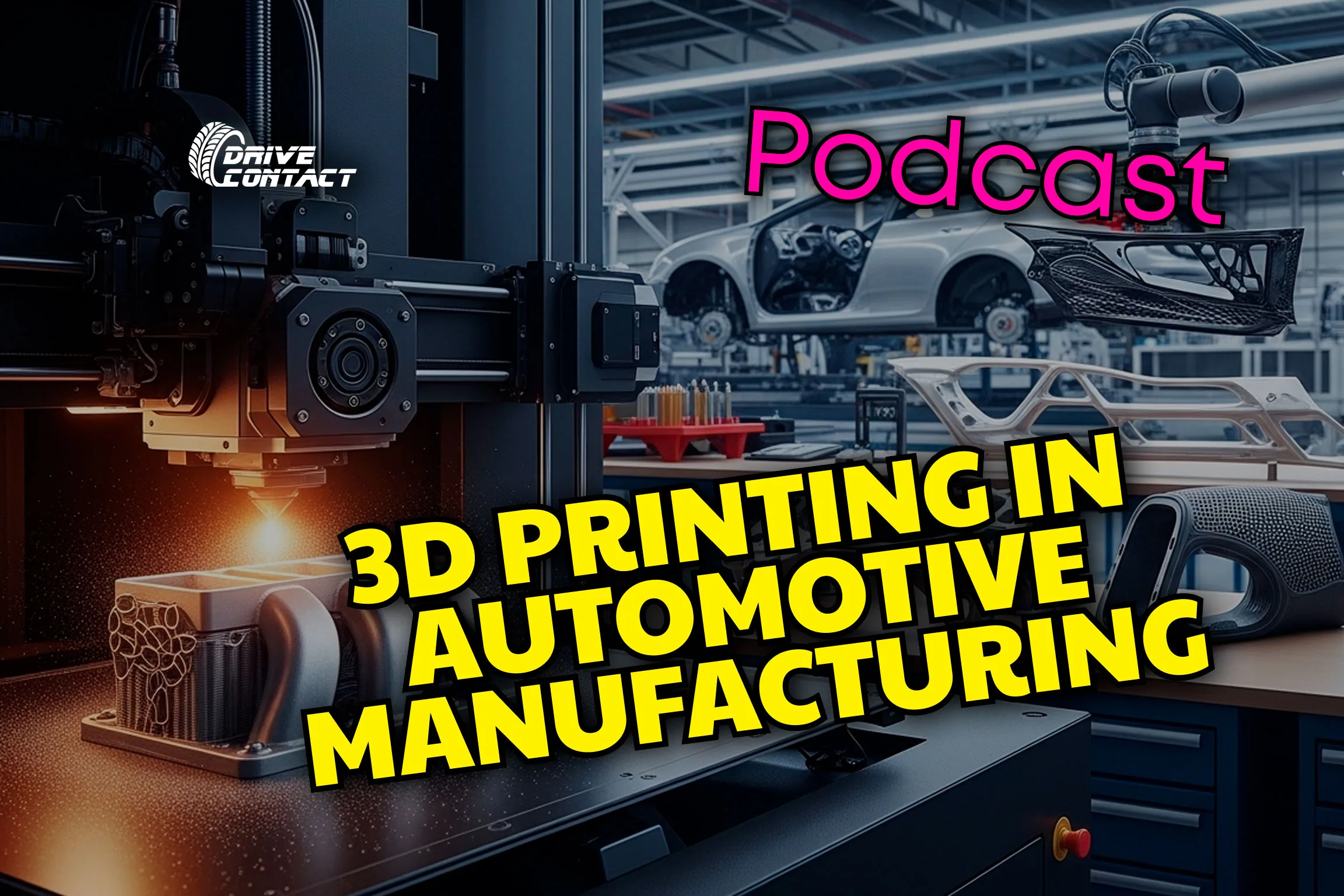
The world of Automotive Manufacturing is undergoing a profound transformation. We are moving past the limitations of traditional casting and machining thanks to the disruptive power of 3D Printing.
This Additive Manufacturing revolution isn’t just about streamlining factory floors; it’s about fundamentally changing how we customize, repair, and preserve the cars we love.
In this episode of the DriveContact podcast, we explore how 3D printing is creating a new era of Future Repairability and why the “garage of the future” looks more like a high-tech design studio.

Tap or click to follow to the podcast page
The New Age of Customization
For the performance enthusiast, 3D printing is a game-changer. It allows for the creation of intricate, bespoke Custom Parts with minimal lead time.
- Complex Geometries: Engineers can now design lightweight intake manifolds or specialized cooling ducts with organic shapes that were previously impossible to manufacture.
- High-Performance Materials: Using carbon-fiber-reinforced composites and metal alloys, independent shops can now produce parts that meet the durability demands of professional motorsport.
- Democratized Design: This technology empowers DIY builders to achieve professional-grade results on a budget, perfectly contouring parts to their specific engine bays or bodywork.
Ending Part Obsolescence
One of the most significant impacts of this technology is securing the long-term survival of classic and rare vehicles.
- Digital Inventory: Manufacturers are shifting toward a model where design files are archived electronically. Instead of maintaining vast warehouses, a part can be 3D printed on-demand at a regional center.
- Reverse Engineering: If a part is no longer made, a 3D scan of a broken original can be used to generate a perfect replacement file.
- Industry Validation: Major players like BMW, Ford, and Volkswagen are already leading the charge. Ford’s catalog of 3D-printed components has surpassed 5,000 items, while GM recently used the tech to accelerate the production of 30,000 vehicles by printing critical aerodynamic seals in weeks rather than months.
Driving the Numbers
The scale of this shift is backed by massive growth. As of 2026, the global automotive 3D printing market is valued at approximately $6.67 billion, with a projected surge to over $23 billion by 2035.
| Metric | Detail |
| Market Share (2026) | ~ $6.85 Billion |
| Dominant Technology | FDM (Fused Deposition Modeling) at ~37% |
| Fastest Growing Material | Metals (19% CAGR) |
| Key Player Integration | Ford (5,000+ parts), VW (HP Metal Jet adoption) |
3D Printing is the most significant technological leap in manufacturing since the assembly line. It ensures that the passion and innovation within Car Culture will never go out of production.




Functional Always active
Preferences
Statistics
Marketing