
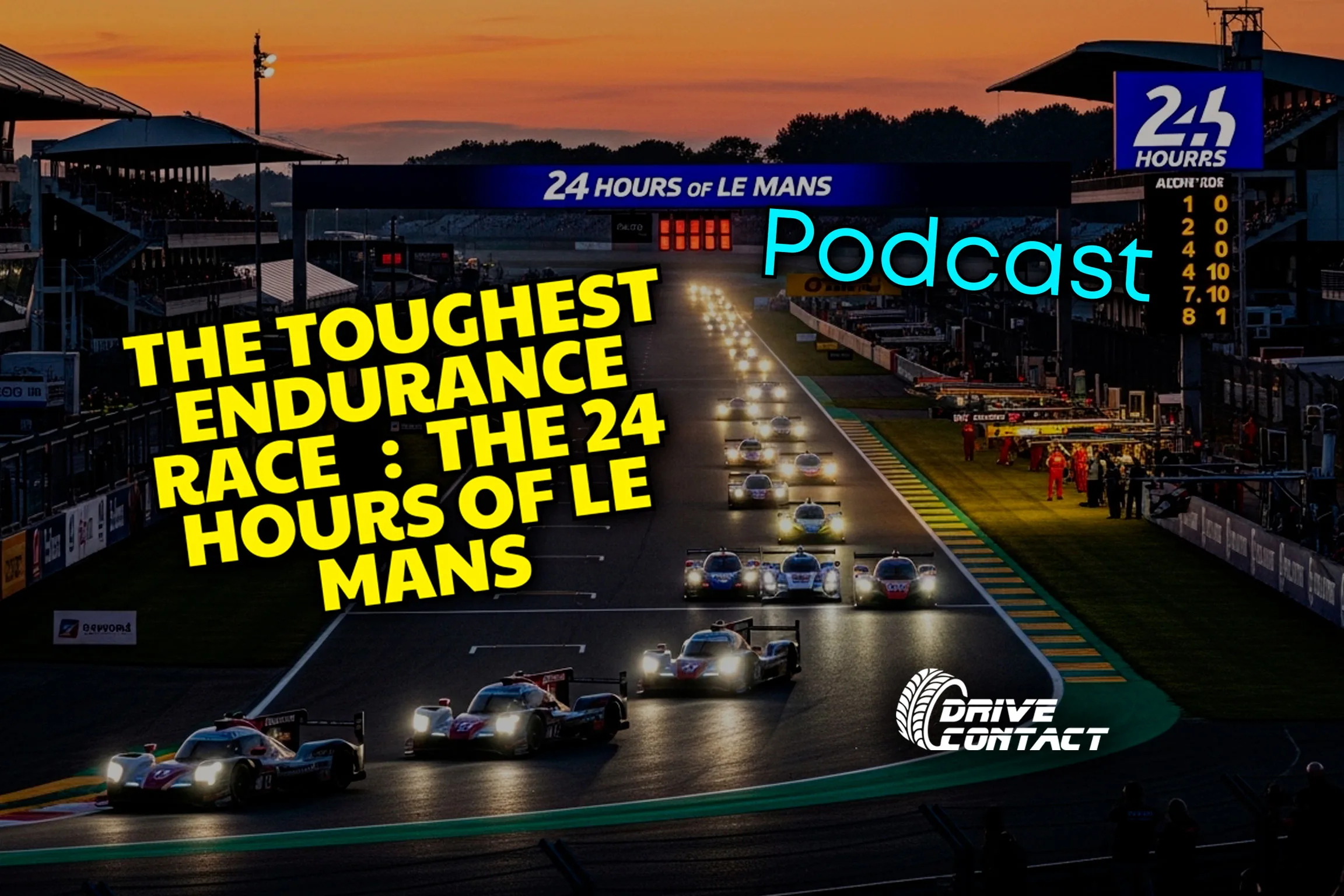
The 24 Hours of Le Mans is more than just a motor race; it is the ultimate crucible where the limits of automotive engineering and human endurance are savagely tested.
As we look ahead to the 94th running on June 13–14, 2026, the unyielding pressure of the Circuit de la Sarthe continues to provide invaluable lessons that shape the cars we drive every day.
In this episode of the DriveContact podcast, we explore why Le Mans is the world’s most effective real-world laboratory for reliability and innovation.

Tap or click to follow to the podcast page
Reliability Under Extreme Stress
The most profound lesson Le Mans teaches is the priority of survival. Unlike a sprint, a Le Mans prototype must withstand over 3,000 miles at maximum attack—nearly a full season of Formula 1 in a single day.
- Disc Brake Revolution: In 1953, Jaguar and Dunlop pioneered disc brakes on the C-Type to handle decelerating from 150 mph on the Mulsanne Straight. This allowed them to finish 1st, 2nd, and 4th, proving a technology that is now a standard safety feature on every modern road car.
- The Night Shift: Racing through the pitch black led to the development of fog lights and windscreen wipers, as well as the transition from halogen to Xenon and now high-performance LED headlights, increasing visibility from 100 meters to over 1,000 meters.
The Le Mans Tech Transfer
The race serves as a high-stakes R&D program. Technologies perfected here don’t just win trophies; they improve global fuel economy and safety.
| Innovation | Le Mans Impact | Road Car Application |
| Hybrid Systems | Porsche/Toyota/Ferrari Hypercars | Energy recovery in EVs and production hybrids |
| Direct Injection | Audi R8 (2001) | Optimized fuel economy & power in modern ICEs |
| Aerodynamics | Reducing drag for 200+ mph straights | Better battery range and MPG for consumers |
| Connectivity | Real-time telemetry monitoring | Over-the-air (OTA) updates and vehicle health data |
Human Endurance and the “Le Mans Spirit”
Beyond the machines, the 2026 entry list featuring 62 cars and names like Ferrari, BMW, Cadillac, and Aston Martin reminds us that success is built on teamwork.
- Mental Resilience: Three-person driver teams battle crushing fatigue while racing wheel-to-wheel. This has driven advances in cockpit ergonomics and driver-assist safety.
- Global Impact: With a global TV audience reaching 113 million viewers and onsite attendance hitting record highs of over 325,000 fans, the “Le Mans Spirit” continues to define what it means to push the boundaries of human-machine perfection.
Success at Le Mans is a marathon built on meticulous preparation. It embodies the core of Car Culture: the pursuit of innovation and respect for the mechanical systems that deliver us from point A to point B.



Functional Always active
Preferences
Statistics
Marketing